ONE KERNEL. THREE AIRSPACE THEATERS.
The LOOQOE kinetic kernel, adapted for air traffic operations. Physics-based saturation prediction across tower, enroute, and ground-movement domains — before the controller fatigue cascade becomes a safety incident.
Submit Mission QualificationThe Problem
THE SYSTEM IS REACTING. NOT PREDICTING.
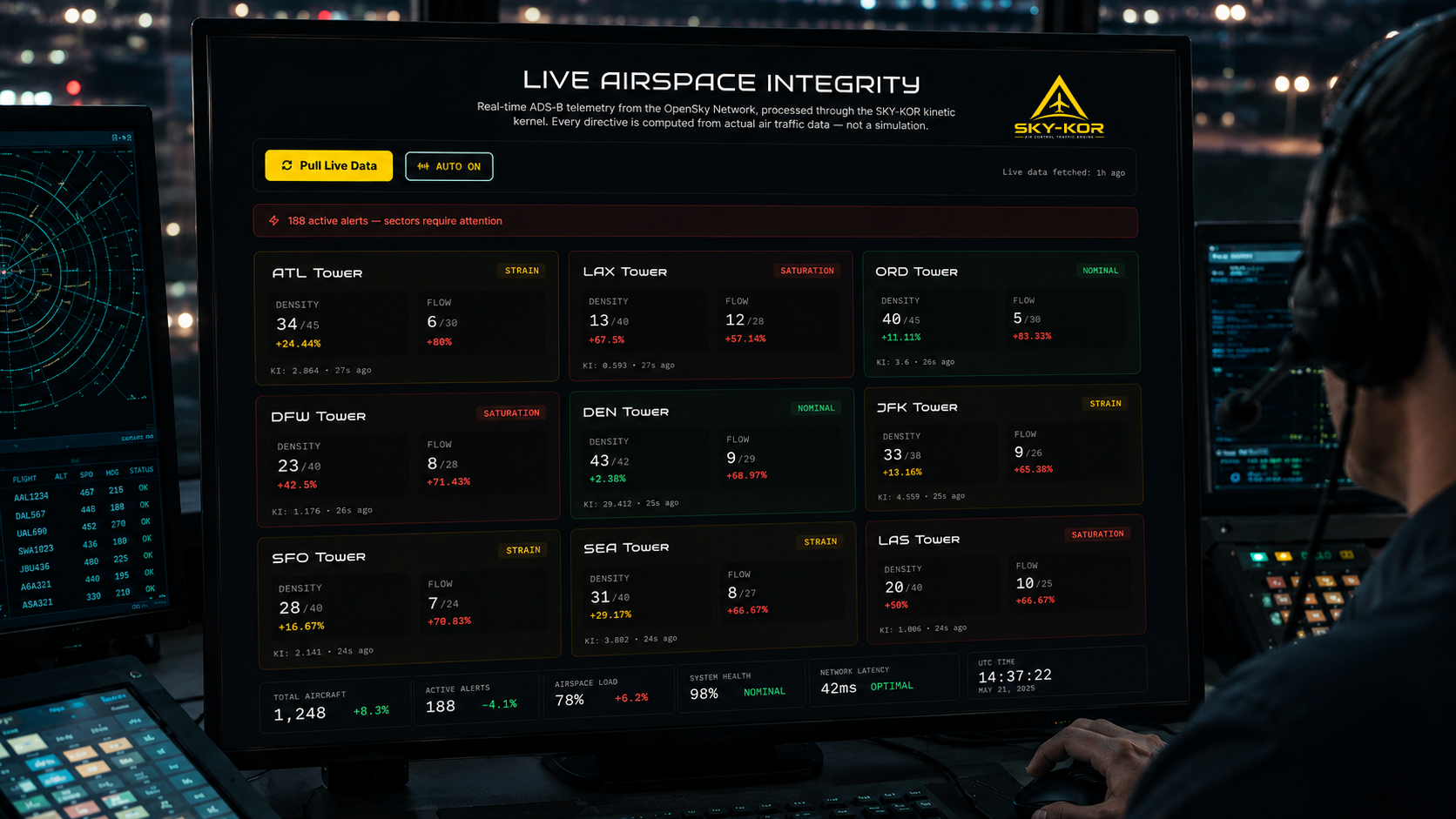
A 3,500-controller shortage. Mandatory overtime. Six-day workweeks. Close-call incidents on the rise. The FAA is fighting yesterday's fire — recruiting after the strain already cascaded. SKY-KOR flips the model: it reads the kinematic trajectory of every sector and issues the flow directive before saturation lands.
A sector trending 35% over plan. A controller workload climbing near-vertical. A fatigue index crossing the rapidity threshold. These are kinetic anomalies — and the kernel catches them before they become delays.

The Three Branches
TOWER · ENROUTE · GROUND
Each branch inherits the same kinetic kernel — deviation, mass, velocity, classification — applied to a different airspace domain. The physics transfers. The sector changes.
SKY-KOR TOWER
Airport Tower · Ground Movement · Ramp
Monitors the kinetic trajectory of tower operations — sector density, controller workload, flow rate, and fatigue. Detects capacity strain before it cascades into ground delays.
Primary Directive: Tower Flow Integrity
SKY-KOR ENROUTE
High-Altitude Sectors · Corridor Flow
Baselines the kinetic mass of enroute corridors. Any sector trending toward saturation triggers a proactive flow-diversion directive — before the handoff chain collapses.
Primary Directive: Corridor Flow Integrity
SKY-KOR GROUND
Surface Movement · Taxiway · Ramp
Reads the kinetic footprint of surface movement — taxiway occupancy, ramp congestion, pushback lag. Flags surface conflicts before they propagate into the air.
Primary Directive: Surface Movement Integrity
The Kernel
FIVE LOOPS. ONE DIRECTIVE.
Every reading runs through the same five-loop physics core. The output is never a chart to interpret — it is a directive to execute.
Deviation
% from sector plan
Mass
Structural digit-reduction
Kinetic Index
M × scale ÷ D
Kinematics
Velocity · rapidity
Directive
Stable · Observe · Divert
Approval Mode Architecture
SUPERVISOR OVERSIGHT ON EVERY DIRECTIVE
Airspace directives require human oversight. Each branch supports three review modes — from full supervisor review to autonomous flow diversion with override.
ADVISORY
Every directive requires supervisor review before action. The engine projects the saturation trajectory; the ATC supervisor decides.
ASSISTED
The engine pre-drafts flow-diversion directives for one-click supervisor confirmation. Reduces cognitive load during multi-sector saturation events.
AUTOMOUS
The engine auto-issues flow-diversion directives to the routing core with a one-click override. Safety-critical directives remain locked to Advisory mode.
Fail-Safe: Safety-critical directives (separation breach, runway conflict) are permanently locked to Advisory mode. The engine can project and recommend — but a human supervisor must authorize every safety-critical action. This constraint is architectural, not configurable.
Audit Provenance
EVERY DIRECTIVE IS REPLAYABLE
Immutable Receipts
Every directive emits an audit receipt — input hash, kinematic snapshot, rule fired, engine version, timestamp. FAA regulators can replay any flow decision without trusting a black box.
Approval Mode Snapshot
Each reading records the facility's approval mode at ingestion time — an immutable record of whether the directive was meant to wait for supervisor review or auto-execute.
DEPLOYMENT
HOW SKY-KOR INTEGRATES
A standardized five-step integration process gets SKY-KOR live on your operation without replacing your existing infrastructure. Full production deployment typically takes 8–16 weeks, depending on operational scope, data availability, cybersecurity requirements, and the condition of your existing telemetry environment. Software overlay only — no new hardware, no rip-and-replace.
CONNECT
Point SKY-KOR at your FAA / SWIM ingest bridge. No new hardware — the engine ingests the same data your operation already produces.
MAP
Map your signal vocabulary to the kinetic kernel. Define your baselines, sectors, and asset labels so the engine speaks your operational language.
BASELINE
Establish the structural baseline for every signal. The engine learns your normal operating envelope — deviation is measured against this, not a generic threshold.
VALIDATE
Run the engine in advisory mode alongside your existing workflow. Confirm the directives align with your operational reality before going live.
DEPLOY
Go live. Choose your approval mode — advisory, assisted, or autonomous — and the engine begins issuing directives with full audit receipts.
HARDENED AT THE GATE
Every inbound telemetry reading is authenticated against a per-license API key and passed through a standardized ingest security layer that enforces input validation, rate limiting, and replay protection. Spoofed, duplicated, or malformed signals are rejected before they ever reach the kinetic kernel — ensuring SKY-KOR only acts on verified, trustworthy data.
AUDIT RECEIPTS
Every directive SKY-KOR issues is sealed with a deterministic audit receipt — an immutable provenance packet containing the input hash, kinematic snapshot, the exact classification rule fired, the engine version, and a timestamp. This receipt enables full compliance replay: regulators and operators can reconstruct exactly why a directive was issued, long after the event occurred.
SKY-KOR is an operational decision support tool, not a safety-critical control system. All directives are mathematical projections based on telemetry deviation and kinematic trajectory. Integration does not modify or replace your existing operational infrastructure.
Mission Qualification
THE AIRSPACE IS IN MOTION.
SKY-KOR READS THE TRAJECTORY.
SKY-KOR is not a retail product. It is a strategic airspace asset deployed through a structured engagement program. Submit your mission qualification profile below — our engagement team will review your operational requirements and reach out directly.